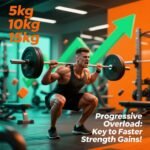


Beginners often experience quick results because almost everything is new to the body. Even light weights feel challenging, so the body adapts quickly.
This phase is sometimes called “newbie gains.”
But as experience increases, progress naturally slows. This doesn’t mean something is wrong — it just means the body has become more efficient.
At this stage, structured progressive overload becomes essential.
Instead of randomly increasing difficulty, training needs to be slightly planned. Tracking workouts becomes useful because it shows whether performance is actually improving over time.
Without tracking, it’s easy to repeat the same effort every week without realizing it.
Strength and the Nervous System
Progressive overload isn’t only about muscles. The nervous system plays a big role in strength development.
When you repeat movements consistently, the brain becomes better at coordinating muscle contractions. This improves efficiency and control.
That’s why exercises feel smoother after a few weeks of practice.
Increasing difficulty gradually allows both muscles and the nervous system to adapt safely.
If weight increases too quickly, technique often breaks down. That increases injury risk and slows long-term progress.
Slow progression usually leads to stronger, more stable results.
The Role of Patience
One of the hardest parts of progressive overload is patience.
It’s easy to feel like small increases don’t matter. Adding one kilogram to a lift or one extra repetition can seem insignificant.
But over months, those small improvements accumulate.
If someone adds just one extra repetition per workout, that becomes dozens of extra repetitions over time. The body responds to that consistent demand.
People who stay patient with progressive overload usually build stronger foundations than those who rush.
Strength built slowly tends to last longer.
Avoiding the “All or Nothing” Mindset
Some workouts feel strong and energetic. Others feel heavy and slow.
That’s normal.
Progressive overload doesn’t require improvement every single session. It requires improvement over time.
Some days are about maintaining performance. Others are about pushing slightly further.
Consistency matters more than perfection.
Even maintaining strength during stressful weeks is part of long-term progress.
Progressive Overload in Everyday Training
You don’t need complicated programs to apply progressive overload.
A simple example:
If you squat 40 kg for 8 reps this week, aim for:
- 9 reps next week, or
- 42.5 kg later, or
- slower, more controlled repetitions
Small progress keeps training effective.
This approach works for beginners and experienced lifters alike.
The principle stays the same — the body adapts to what it repeatedly experiences.
Final Thought
Muscle growth and strength don’t come from random effort. They come from gradually increasing the demands placed on the body.
Progressive overload is not about pushing to the limit every day. It’s about making training slightly more challenging over time while allowing recovery to keep up.
That balance between challenge and recovery is what drives real progress.
In the long run, the people who improve the most aren’t always the strongest or most motivated at the start.
They’re the ones who keep adding small improvements, week after week, without rushing the process.